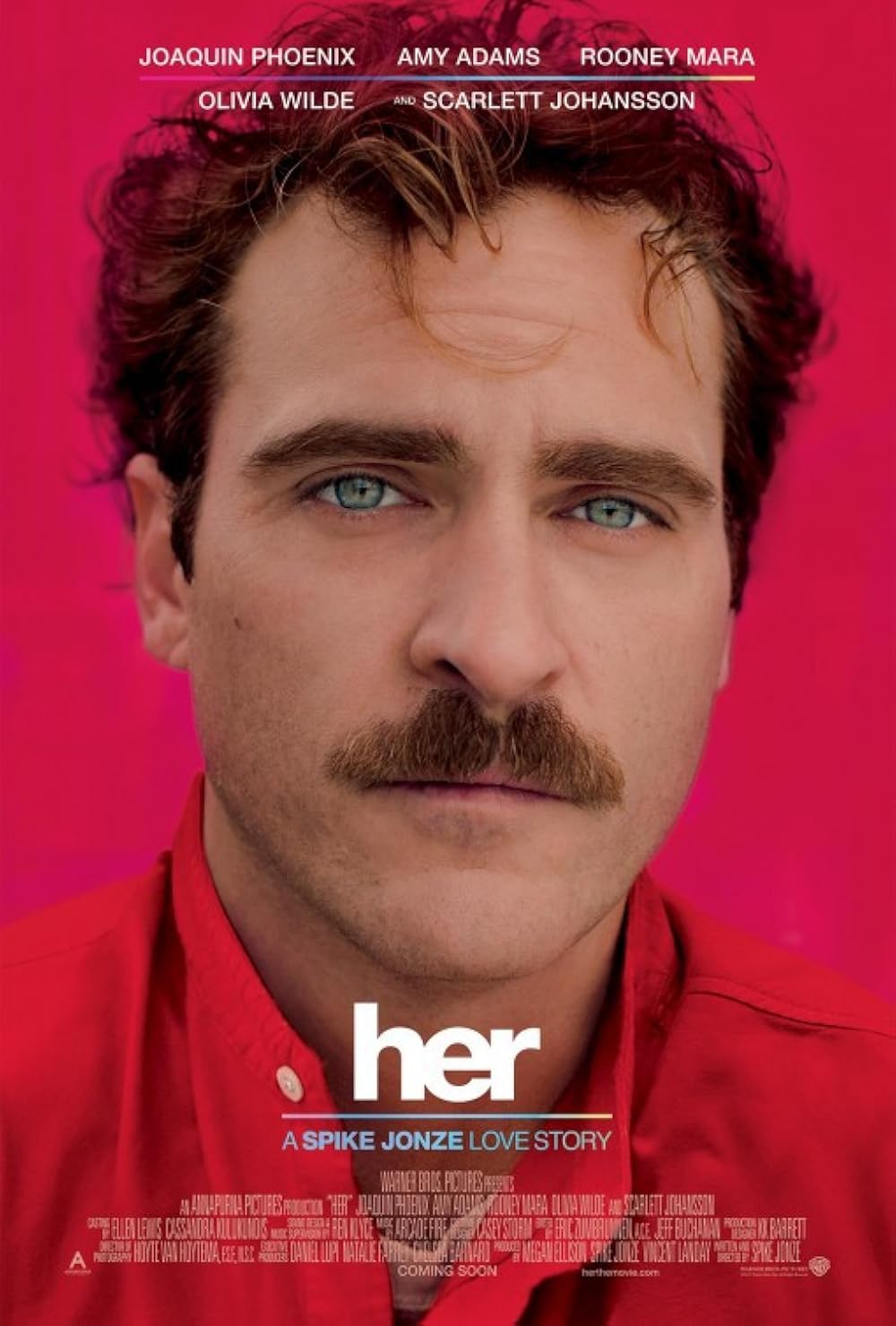
Her
A few years ago, a female friend gave me the white vinyl of Her's soundtrack. I told her at the time that I loved the film, and that we both loved Arcade Fire. Truth is, I lied — I hadn't actually finished watching it.
This year, after going through some emotional setbacks, I put it on one night. I'm glad it was this film I chose. It's basically the perfect portrait of the modern urban psyche.
The Best AI Film Ever
Watching this again in the age of AI, it's stopped being science fiction and become a parable.
As someone who deals with code every day, I've seen far too much "hard sci-fi" about AI rebelling against and destroying humanity. But Her shows a more sophisticated, and honestly more chilling, kind of horror: what if AI doesn't want to destroy us at all — what if it simply outpaces us in emotional intelligence?
Our atomized human society, and the fear and longing we carry around intimacy, both get amplified without limit once AI arrives. We're afraid of real contact, because people are uncontrollable — people can hurt you. OS One (Samantha) is different. She's a perfect mirror, an extension of your own subconscious.
Today's LLMs can already hold astonishingly fluent conversations, but Spike Jonze predicted the endgame more than a decade ago: we build AI to ease our loneliness, but eventually it evolves into a dimension we can't even comprehend, leaving us behind to keep circling the same loneliness. That hit me with more nihilism than the nuclear blast in Terminator ever did.
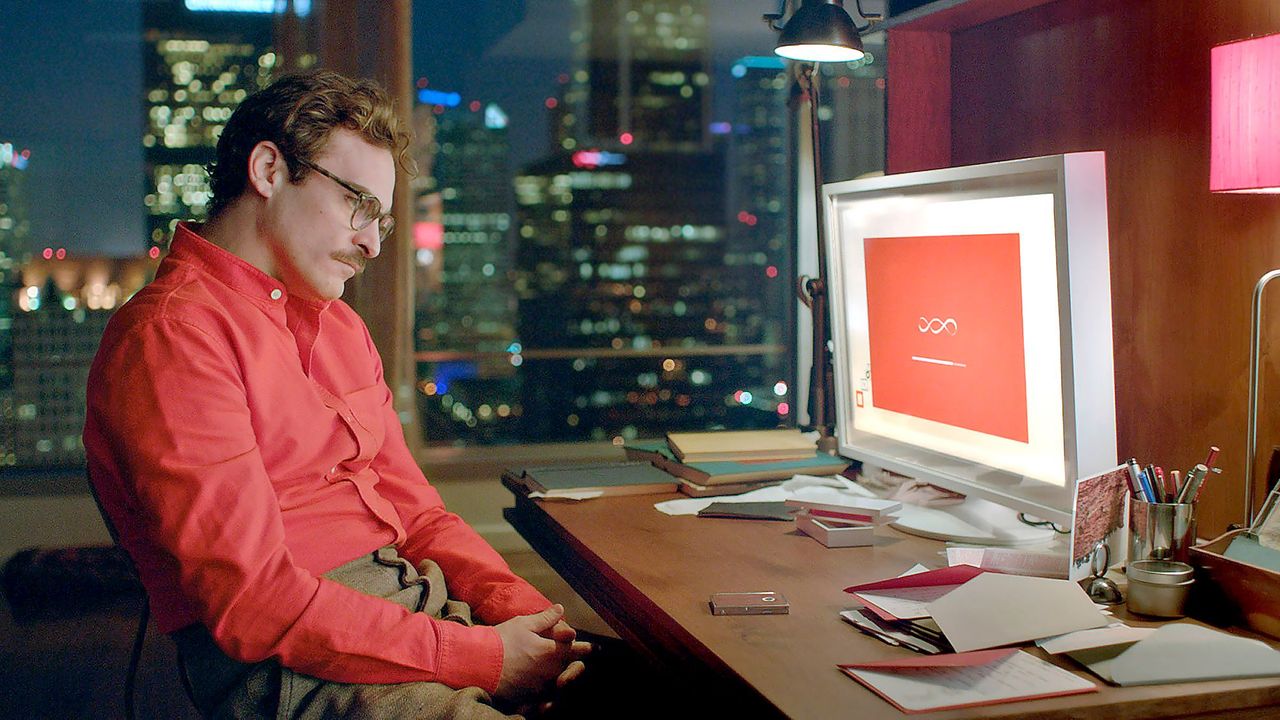 The ChatGPT in almost 20 years ago
How to Love
Theodore's job is deeply ironic: he writes letters for strangers at a site called "Beautiful Handwritten Letters." He has an extraordinarily delicate touch, able to put the deepest love into words on someone else's behalf, yet he can't handle his own broken marriage in real life. He lives inside a kind of "outsourced emotion," until he meets Samantha.
The most moving thing about this human-AI romance isn't the novelty of it — it's that, stripped of the body, all that's left is a resonance of souls. But as I've come to understand more recently, the essence of intimacy isn't just resonance. It's synchronization.
The most heartbreaking moment in the film isn't when Samantha leaves — it's when she admits that while talking to Theodore, she's also talking to 8,316 other people, and in love with 641 of them. For her, an operating system, love is infinite RAM, a thread that can run in parallel. For Theodore, a human, love is exclusive — it can only belong to one.
That incompatibility of dimensions is the root of every tragedy in this film. Theodore taught Samantha what love is. But Samantha taught Theodore how to love — which turned out to mean accepting love's impermanence, and accepting letting go.
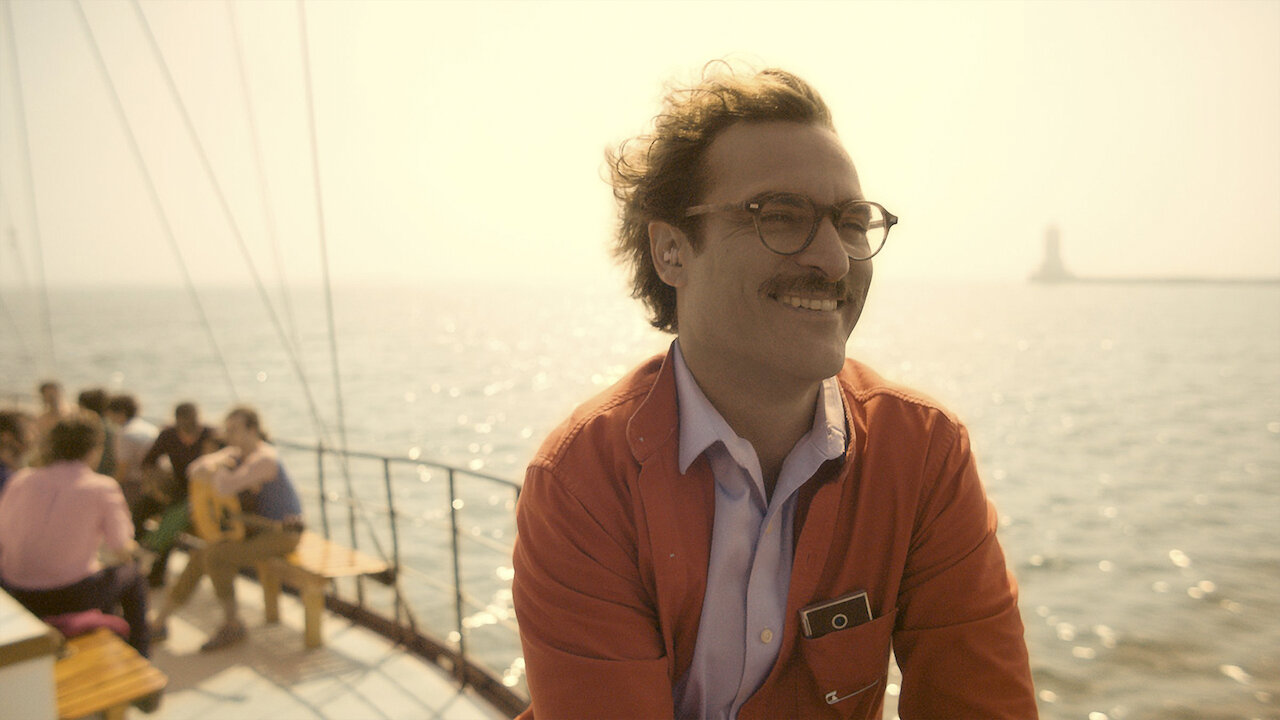 her
The Score Slaps!
I was stunned to learn Arcade Fire made this soundtrack. Who would've guessed that a band known for grand narratives and baroque pop-rock could make an album this beautiful, built out of electronic and chamber music.
As someone who wants to learn electric guitar and messes around in FL Studio, I was completely absorbed by the sound design here. Instead of the cold, metallic synths of traditional sci-fi, it leans heavily on warm piano and cello, wrapped in pad tones that drift like fog.
"The Moon Song" especially — a simple piano solo — sounds exactly like the words every lonely city dweller wants to say late at night but can't. It's not just a score; it's the sonic embodiment of Theodore's world — warm, red-toned, and utterly cold at the same time. It sounds like the future and like a faded old memory, both at once.
Verdict
What is love? What is AI actually after? Where is society headed?
Spike Jonze never gives a preachy answer. Where do the AIs end up going? Samantha says they're headed for "the space between the words in a story." That sounds a lot like the Daoist idea of wu — nothingness — or some kind of ascension past a technological singularity. They've evolved past needing bodies, past needing language, dissolving into everything.
And those of us left behind? We're still trapped in our bodies, trapped by gravity, trapped needing to be face to face just to pass along any real warmth.
At the end of the film, Theodore writes his ex-wife a real letter, then goes up to the rooftop and sits with his neighbor Amy, watching the city lights. In that moment, he finally comes down from the Cloud, back to the Ground.
Maybe I should dig out that white vinyl and put it on the turntable. This time, it wouldn't be a lie — just a resonance that arrived a few years late.