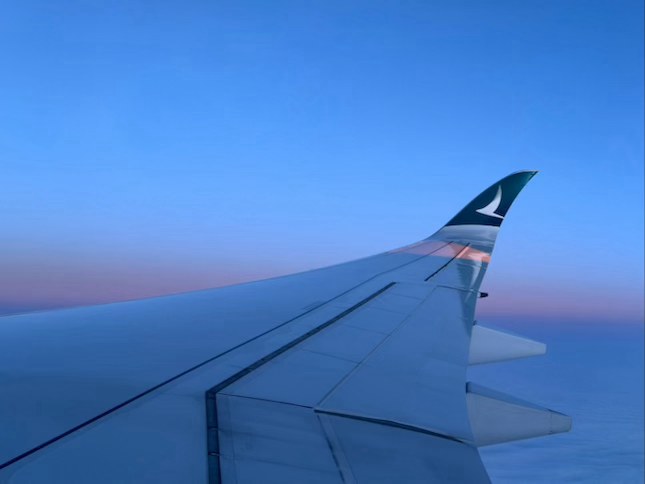
Plane Movie Marathon Time Again
Predator: Badlands
Didn't finish it, wasn't really into it. Even with Elle Fanning in it, I couldn't get into this one.
The Current War
Surprisingly decent — it got a lot of Edison's controversies on screen. Tesla is pretty much a background character here; the film mainly focuses on the AC/DC feud between Westinghouse and Edison.
That era had just as many new technologies and inventions as this one does. And just like now, capital was the force pushing everything relentlessly forward. But the difference is, there's no such thing as an "inventor" anymore. Now there are only entrepreneurs, engineers, and scientists.
The age of the inventor is over.
One more interesting detail: the film's ending mentions that Tesla oversaw the construction of the Niagara Falls power station. I'd actually been there once with a few friends — had no idea the history went back that far.
As for Edison's arc, it ends with him having lost the electricity war but having invented the film industry instead. As a story carried by a film, that meta touch was pretty fun.
The Golden Era
Tang Wei is just too supermodel for this world — she's believable as the muse of literally any romantic young writer. The moment Xiao Hong and Xiao Jun fall in love might be exactly the moment of love I'm chasing myself. The way they clung to each other through poverty is precious too. Unfortunately, what I've seen in one girl only ever showed me one side of it, and what I've seen in two other girls only showed me one side too.
Xiao Jun has things I can't do — for one, he has his own media presence and communication skills. When something goes wrong, he's good at solving it on the spot, like that broken shoelace. Whereas I don't have my own media to let people see what I'm thinking. So having your own media, understanding communication — that stuff really matters. Making people interested in my image matters.
If you dropped Xiao Hong into today's world, she'd honestly land somewhere close to a "collapsed-start Xiaohongshu it-girl" — except she actually had the talent, which is the fundamental difference between her and an actual collapsed-start it-girl.
What I found most interesting about The Golden Era was its narrative technique — every character gets a moment breaking the fourth wall for a monologue, and performance-wise, it genuinely feels like the audience is watching them in real time. It carries a bit of a Wes Anderson feel, like any character could turn and say a couple words to the audience at any moment.
The narrative structure constantly uses each character's own account to fill in the transitions across different points in time. Given that it's a film about writers and literary figures, that technique fits particularly well.
Life is always moving from one stable state to another, and I can always tell exactly when I'm in that in-between stretch. It's a kind of uncertain, anxiety-tinged stretch of time.
But things are often at their most beautiful right when they're changing — like the sky at sunrise or sunset, blazing with color, spectacular.
So the so-called "golden era" might not actually be a peaceful one at all — it might well be a dark one. But it has to be an era of intense change, an era where the winds are rising and the clouds are churning.
I think we're living in that golden era right now.
As for the love story between Xiao Hong and Duanmu, I'll admit I'd genuinely like to know what actually happened historically. Another thing this film does well: it doesn't force explanations onto a lot of historical mysteries that were never truly resolved — Xiao Jun's affair, why Duanmu went to Chongqing alone, and so on. Instead of forcing a resolution, the film chooses to preserve the mystery, staying only within what the narrator actually knows. That gives the film an unusually documentary-like sense of authenticity.
I didn't expect the ending to suddenly loop back to Tales of Hulan River from the opening, telling the audience the book was written in 1941 — the height of wartime chaos. The scene of Huang Xuan eating candy while crying, it turns out, comes from this film's ending too.
Because there are different writers, and different novels. Not everyone needs to write about the present moment — some people might land closer to something more essential.
I have to give credit to this film's editing and the performances. Everything feels remarkably lived-in — Hu Feng and the actress playing his wife were especially good. Tang Wei goes without saying. The only weak link might be whoever played Tang Wei's younger brother.
The editing leaves a lot of threads dangling on purpose, so you can never quite pin down the narrator's identity, or who's actually listening in. It then uses the narrator and the listener to tell the audience the current timeframe, and how the relationships between characters have shifted.
A really good film.
Oh, and I only just found out this was directed by Ann Hui. That explains everything.
Hotel Rwanda
Someone in the comments put it well: Africa's Schindler's List. At its core, it's a Hollywood personal-hero story woven around a fair amount of real historical fact.
What makes Hollywood so powerful is its ability to pick exactly the right material — satisfying Western audiences' appetite for the exotic while also showing off its own empathy, and slipping its values in along the way, all at once.
So-called "telling China's story" doesn't necessarily mean telling a story about China. Hollywood figured this whole playbook out a long time ago.
My Uncle
The very first few shots of blocking already show off Tati's extraordinary skill. Not a single line of dialogue, yet every character and object's placement, every entrance and exit within the frame, is meticulously designed. Every shot looks like a modernist painting.
Honestly, the way that front-gate shot is designed is fantastic — it reminded me of the shot in Zodiac where Robert Downey Jr. and the Zodiac Killer's letter make their entrance. And even earlier than that, the deep-focus shots in Citizen Kane.
The story is actually about a silent-film-era performer transplanted into the world of talkies, feeling completely out of place (lol).
What makes this film so impressive is how it keeps switching back and forth between two entirely different comedic styles, two entirely different visual styles.
On one side: cold-toned, clean, modern, automated, meticulously ordered upper-class society — or you could call it contemporary adult society. On the other: warm, run-down, lived-in, rowdy, playful — the world of kids and ordinary people.
One side is an awkward comedy of manners satirizing the middle and upper classes, which surely went on to influence Ruben Östlund, director of The Square and Triangle of Sadness. The other side is physical comedy, carrying real echoes of the silent-film era.
If Parasite didn't take the garden-party scene with the little boy doing his "Indian dance" as a direct reference, I'll eat my hat.
That said, the factory sequence making plastic sausage tubing later on genuinely didn't make me laugh. Maybe I just have zero patience for people who can't get their act together, and honestly, industrial production really shouldn't be a joke.
But this film's satire of every kind of high-tech gadget really does land — a lot of the "features" on new-energy vehicles today are just as absurd as that fountain, or that garage sensor door. Amid all the noise generated by technology — like today's video platforms — a whole family can end up not hearing each other at all.
But that's fine too — even the stiff, old-fashioned father eventually learns to whistle and joke around, finally reaching out and holding his kid's hand. The final shot goes back to a few dogs wandering the street.
Someone in the comments mentioned this film connects into the director's later work, Playtime. Now I'm curious.
One Battle After Another
Rewatched the opening this time, and it made me a little nostalgic for watching this film in theaters.
I noticed that the character older Leo plays has almost the exact same energy as a friend of mine — even a lot of the same expressions in his eyes.
Comparing it to Punch-Drunk Love, you can really see how far PTA has come.