
This Is Us, Under Today's Atomized Society
Went to see the rerelease of this one at Imagine Cinema on Carlton recently, with a few friends who love film as much as I do. Great experience — this rewatch was the first time it really hit me how black-comedy this film actually is. We were laughing pretty much the whole way through.
 The showtime screen for American Psycho at Imagine Cinema
Rewatching American Psycho this time, I found that its discussions of appearance, consumerism, materialism, sex, and death are surprisingly close to many of my own fantasies. It also shares a lot of the same underlying ideas as a short film script I once wrote called Night Run.
Looking back, that era produced many films about the disturbed inner worlds of urban white-collar workers, such as Fight Club and American Beauty. More than twenty years later, those of us living in East Asia have begun to experience something remarkably similar. It is hard not to marvel at the enormous time lag created by the development of the world, almost as if history itself were some kind of time machine.
From here, I want to explore two directions. One is a kind of psychological analysis of myself, and perhaps of the experience of contemporary young, single people living in cities. The other is a critique of Night Run and how I might revise it.
I’ll start with myself.
There is one scene in American Psycho that I found particularly relatable. Bateman is talking on the phone while a pornographic film plays in the background as ambient noise.
It’s embarrassing to admit, but I’ve actually done this myself, more than once.
If I try to analyze why, I think it was a way of feeding a lonely mind with the sound of intimacy. The sexual sounds in the background act as a kind of stimulus. They remind you of what intimacy is supposed to feel like.
But ultimately, it is futile, because those aren’t actually the sounds of intimacy. They are manufactured representations of the intimacy people fantasize about.
Put simply, it’s like drinking poison to quench your thirst.
And this seems to point toward one of the deepest questions at the heart of American Psycho: how does a person confirm that they exist?
Bateman is constantly trying to make himself visible to other people. His clothes, his body, his business cards, his job, restaurants, women, musical taste, and even the meticulous way he manages his lifestyle are all constantly sending signals to the outside world:
“Look at me. I am valuable. I am someone worth noticing.”
What he may actually lack, then, is not any of these things, but a sense of self that does not need to prove itself through them.
He constantly displays himself because he seems unable to derive enough of a sense of existence from within. He needs people to see him. He needs people to acknowledge him. He needs to establish his position by comparing himself with others.
So when someone has a better business card, gets into a more exclusive restaurant, has a higher social status, or is more desired by women, these things are no longer merely ordinary competitive losses. They begin to feel like a denial of his very existence.
This also makes me think about myself, and about a dilemma that people of my generation often find themselves trapped in:
Are we displaying ourselves because we want to express who we are, or are we using self-display to convince ourselves that we exist?
Another example of this strange time-machine phenomenon is the way people simultaneously hate and obsess over their own bodies.
Bateman’s narcissism is obvious. He even admires his own muscles in the mirror while having sex with a sex worker. Every morning, he goes through an elaborate skincare routine simply to preserve the elasticity, firmness, and youthful appearance of his face.
And this is essentially what people do on social media every day. Everyone gets a certain narcissistic pleasure from looking at themselves and receiving admiration.
At the same time, however, people can be deeply dissatisfied with their own bodies, to the point that they exhaust themselves trying to make their bodies more beautiful.
Contemporary East Asian society increasingly expects men to be polished and aesthetically refined, but men and women seem to interpret this very differently.
Some men see it as a symbol of the “Sigma male” mentality: I only love myself.
Others see it as a means of gaining sexual access and attracting partners.
Many women, meanwhile, see it as another form of competition between men.
Personally, I find a more provocative summary more convincing: many men may actually be less interested in women than they are in their own position within the male hierarchy. In other words, at some level, they’re really gay.
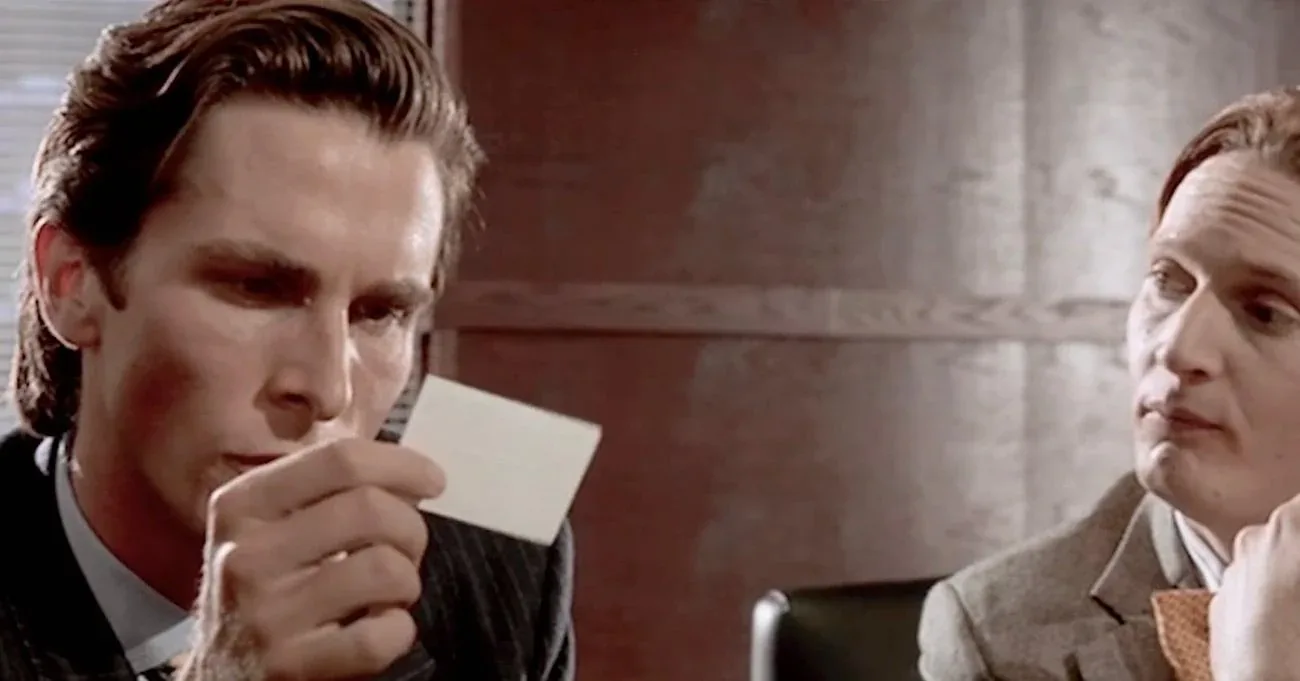
This is portrayed particularly well in the film. A group of men compare their business cards in the office, then sit in bars talking about women, careers, work, and their taste.
But underneath all of that, what they really care about is their position within the male hierarchy: who is at the top, and who is at the bottom.
I’ve spent a lot of time criticizing Bateman, but now I have to turn that criticism toward myself, because in many ways, I am surprisingly similar to him.
I’m not saying I think I’m as handsome as Christian Bale. I have enough self-awareness for that.
What I mean is that, after going through various experiences in society, I’ve also started working out. I’ve learned about skincare, makeup, and fashion. I take pride in my work.
Like Bateman, I can talk endlessly about music and records to demonstrate that I have taste. I recommend records to almost anyone who comes to my apartment. I like to mention how many concerts I’ve been to. I also carefully curate my social media and organize the way I present myself online.
But that’s precisely where the problem lies:
Do I actually like these things, or do I like the version of myself that owns these things?
How much of my exercising is because I genuinely enjoy having a strong body, and how much is because I want that body to be seen by other people?
Do I buy vinyl because I genuinely love music, or because vinyl can function as a symbol of “being a person with taste”?
Do I work hard because I genuinely enjoy creating things, or because professional achievement allows me to prove that I am a valuable person?
There probably isn’t a clean answer to any of these questions. In many cases, both motivations simply exist at the same time.
As the film suggests toward the end, what is actually inside you almost becomes irrelevant. In a consumer capitalist society, everything becomes a symbol. Anything you do to demonstrate that you have some kind of inner substance can be transformed by consumerism into a symbolic performance, then packaged and sold.
The absurd part is that we almost have to participate in this system. If we don’t, we may no longer be perceived as people with taste or substance.
Even “anti-consumerism” itself can become a consumerist symbol.
I don’t buy luxury goods. I like independent films. I listen to underground music. I collect vinyl. I read philosophy. I like niche design. I reject mainstream culture.
All of these things can be packaged into the same message:
“I am sophisticated. I am thoughtful. I am not vulgar.”
So the problem is no longer simply consumerism itself.
The deeper question is whether we can still distinguish between the desires that genuinely belong to us and the desires we have simply learned to have.
I used to be a very strong introvert. These days, I’m much more extroverted. I increasingly feel that things need to be displayed, because we now live in an image-driven, highly mediated age. You have to carefully present yourself before other people can begin to understand you.
But I still retain many of my old introverted habits. I still like to hide certain things I want to express, leaving them just obscure enough that only people who genuinely want to look for them will find them.
I’ve also started buying furniture and other things that make the objects in my apartment easier to display, such as my vinyl records, figures, and books. My weekends have gradually become busier as well. In the past, I preferred staying home alone, watching videos, watching movies, or working on projects.
I feel like I’m moving toward a much brighter and healthier way of living.
But I also worry that perhaps I’ve completely fallen into the sweet, barren trap that capitalism, consumerism, and neoliberalism want me to enter.
Maybe the real question isn’t whether presenting yourself is inherently hypocritical.
Someone who completely refuses to present themselves isn’t necessarily more authentic. They may simply be giving other people no opportunity to know them.
In this age, we inevitably have to communicate ourselves through our clothes, photographs, music, work, interests, homes, and social media.
The real question is:
How much distance remains between the person we present and the person we actually are?
I can display my vinyl collection without having to explain everything about myself.
I can dress carefully without turning my body into a billboard.
I can work hard and enjoy being recognized for what I accomplish, without allowing those things to become the ultimate basis for deciding who I am.
I can be seen, without allowing myself to be completely consumed.
If this conflicted and distorted mentality is taken to an extreme, it can become a kind of psychological disorder. In the artistic world, writers and filmmakers often represent that disorder through death.
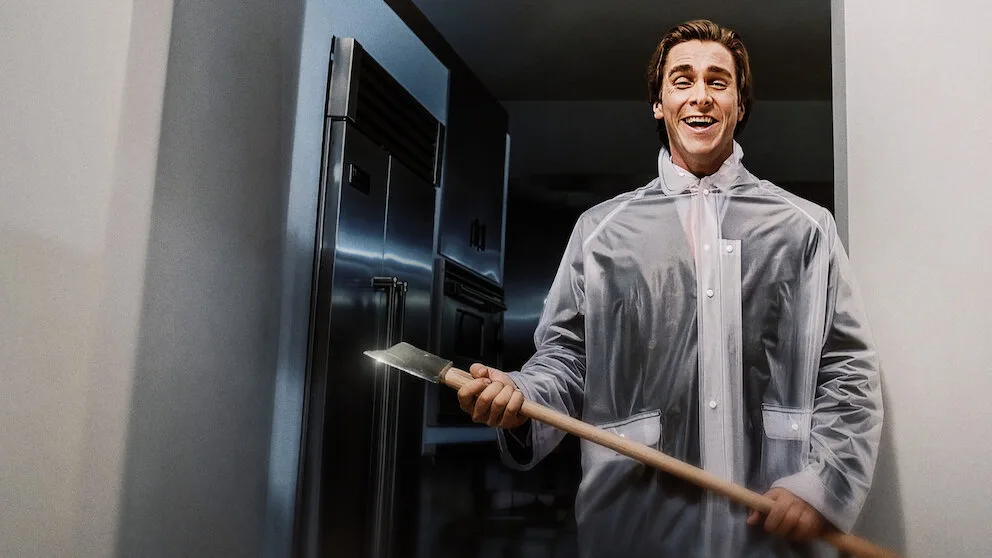
And since we’ve arrived at death, let’s talk about the short film script I wrote, Night Run.
The story of Night Run is simple.
An international student lives alone in the suburbs of a foreign country while working from home. After falling victim to a financial scam, he feels humiliated and manipulated, and decides that he wants to understand what real crime actually looks like.
He starts watching true-crime stories. Over time, he becomes increasingly fascinated by how poorly most criminals actually plan their crimes. Eventually, he begins wondering what it would take to commit the perfect crime.
To relieve his loneliness, he starts going out for night runs. One night, he accidentally discovers a door that has been left slightly open, and sneaks inside.
Eventually, he begins to enjoy breaking into people’s homes.
Then one day, while breaking into a house, he accidentally discovers a murder scene.
But instead of calling the police, he carefully observes the murderer’s methods. He decides that he wants to imitate them and use the same method to kill someone else.
I’ll leave the rest of the story unspoiled.
I agree that the protagonist’s motivation for imitating the murder is somewhat abrupt. So let me talk about myself instead. Perhaps there is something interesting to be found in the motivation behind it.
I’ve had a bad habit since childhood of secretly doing things I wasn’t supposed to do.
These things weren’t necessarily particularly harmful or immoral. I knew better than to do things that were truly terrible. What fascinated me was precisely the gray area: crossing a boundary somewhere no one could see.
After moving to Canada, I realized that there were periods of time that belonged entirely to me. Nobody was looking for me, and nobody was restricting me.
So I started fantasizing about whether I could secretly do things that belonged entirely to myself.
The feeling is actually similar to walking aimlessly along an endless road on a cool, overcast day, stopping and starting without any particular destination, while the gentle rain slowly soaks into every inch of your skin.
You can breathe in the fresh air as deeply as you want. You can sing loudly to the vast, empty sky. Nobody is disturbed by you, and nobody can hurt you.
That’s why I wrote the protagonist as someone who breaks into other people’s homes.
Looking back now, I think Night Run and American Psycho are actually searching for the same thing, but in completely opposite directions.
Bateman wants to be seen.
He constantly displays his body, wealth, taste, social status, and sexual attractiveness, trying to confirm who he is through the eyes of other people. He is afraid that he is insignificant, so he constantly has to prove that he matters.
The protagonist of Night Run, by contrast, wants to disappear.
He lives alone in the suburbs of a foreign country. Nobody knows where he is. He runs alone at night, enters houses without anyone noticing, and does things that nobody knows about.
He even fantasizes that if he died during evening study in high school, perhaps nobody would notice until the study session was over.
One person desperately wants to be seen by others.
The other wants to enter a world where nobody can see him at all.
But ultimately, they are asking the same question:
If nobody sees me, do I still exist?
And, going one step further:
If everyone sees me, are they actually seeing me?
As for the financial scam, that part came directly from my own experience.
I really was scammed. The scam involved me being manipulated into believing that I was assisting with an investigation into a financial crime. I genuinely believed that the whole thing was real.
Part of the reason I fell for it was that, as a student, I felt disconnected from society. Afterward, I genuinely started watching true-crime stories because I wanted to understand the darker side of the world and protect myself from worse things happening.
It was also connected to the place where I used to live in Markham, which had a lot of huge, empty stretches of land.
I used to have this strange feeling that if someone died there, nobody would ever know. In a way, it felt the same as nobody knowing that I lived there.
(I actually do have quite a few friends.)
When I was in high school, I sometimes imagined that if I died during evening study, perhaps nobody would notice until the study session was over.
I found that idea strangely ironic.
(I actually had quite a strong presence at school.)
I am afraid that I might think too highly of myself, believing that I am important when perhaps I’m not important at all, and that maybe nobody actually needs me.
That insecurity is not so different from Bateman’s constant need to confirm his existence through external possessions, comparison, and recognition.
Whenever something refuses to validate him, whether it’s the restaurant he can never get a reservation at, someone’s better-looking business card, or another man being more popular with women, he becomes obsessed with destroying it.
And when even that isn’t enough, he turns toward people who are weaker and more vulnerable, such as homeless people and sex workers.
What he cannot accept is not simply failure. It is what failure seems to imply:
If I cannot prove myself through these things, then who am I?
Night Run, meanwhile, moves toward the opposite extreme.
Its protagonist tries to escape the gaze of everyone else and find a secret world known only to himself.
Breaking into houses isn’t necessarily about stealing anything. It is more like a fantasy of agency:
“I can enter a place that nobody knows I have entered.”
Nobody knows that I was here.
Nobody knows where I am.
Nobody knows what I have done.
For that moment, I belong completely to myself.
This is why, when I reconsider Night Run now, I think its real question may not be “Why would someone suddenly want to kill someone?”
It may instead be:
How far can a person go in trying to prove that they are the master of their own world?
And this also makes me understand American Psycho differently.
Bateman confirms his existence by being seen.
The protagonist of Night Run confirms his existence by disappearing.
One reaches outward for validation. The other retreats inward to escape it.
But ultimately, both confront the same question:
Can a person possess a sense of existence that does not depend on other people’s confirmation?
This may be the truly difficult part of what we call agency.
We often mistake agency for “I don’t need anyone.”
But perhaps genuine agency is not that simple.
A person can need other people. They can love other people. They can want to be liked. They can enjoy material possessions. They can enjoy being recognized by others.
The question is whether, when all of those things disappear, they can still know who they are.
I’ve increasingly realized that cars, houses, money, careers, bodies, degrees, taste, and even love cannot give someone genuine agency.
In the past, I might have imagined that once I had a car, I would feel more masculine; once I had a house, I would feel more secure; once I owned more things, I would become stronger, more valuable, and more worthy of love.
But looking back, this is also a very typical consumerist logic:
I am incomplete because I am missing something.
Once I possess it, I will become the person I want to be.
But if nothing inside me actually changes, then the version of me who owns more things may simply be the same old me with more things.
The truly difficult thing is neither completely escaping consumerism nor eliminating all material desires.
It is learning to live within it without completely surrendering the authority to decide my own value.
I can buy a car, but the car cannot tell me who I am.
I can buy vinyl, but the vinyl cannot prove that I have good taste.
I can work out, but my body cannot determine my worth.
I can work hard, but my achievements cannot become the only proof that I exist.
I can want to be loved, but someone’s leaving cannot prove that I am unworthy of love.
Perhaps “being the master of yourself” does not mean completely escaping the outside world.
It means gradually learning to distinguish between the things I genuinely want and the things I only want because I need them to prove something about myself.
Even now, I don’t think there is a perfect answer to this problem in contemporary society.
Everything has to exist in a state of constant movement. We can only keep confronting these contradictions, trying to dissolve them, and eventually learning to coexist with them.
It’s a little like the idea of contradiction in Mao’s On Contradiction. There will always be a principal contradiction, surrounding society, surrounding you, and surrounding every individual.
If all contradictions were truly resolved, life itself would become static.
So now I’m trying to forget about all of this.
There is a saying about the three stages of understanding:
First, you see a mountain as a mountain.
Then, you see that a mountain is not a mountain.
Finally, you see a mountain as a mountain again.
But now I think that “seeing the mountain as a mountain again” doesn’t mean becoming ignorant again.
Perhaps it means that after realizing that the mountain is not simply a mountain, you can still choose to climb it.
I know that a car is just a car.
A house is just a house.
Vinyl is just vinyl.
A body is just a body.
A job is just a job.
And love is not evidence that I exist.
But I can still love all of these things.
Knowing that these things cannot answer the question “Who am I?”, and choosing to have them anyway, may be what allows them to become part of life again.
Perhaps knowing all of this and then choosing to let it go is ultimately the best way to live.
Because in the end, what I really want may never have been a world where everyone can see me, nor a world where nobody can see me.
Maybe I want something in between.
A world in which I can tell myself:
Even without applause, without comparison, without consumption, and without other people’s gaze, I still know who I am.
I can be seen, and I can disappear for a while.
I can be loved, and I can be alone.
I can own many things, without needing any of them to prove something about myself.
Perhaps only then can I truly become my own master.