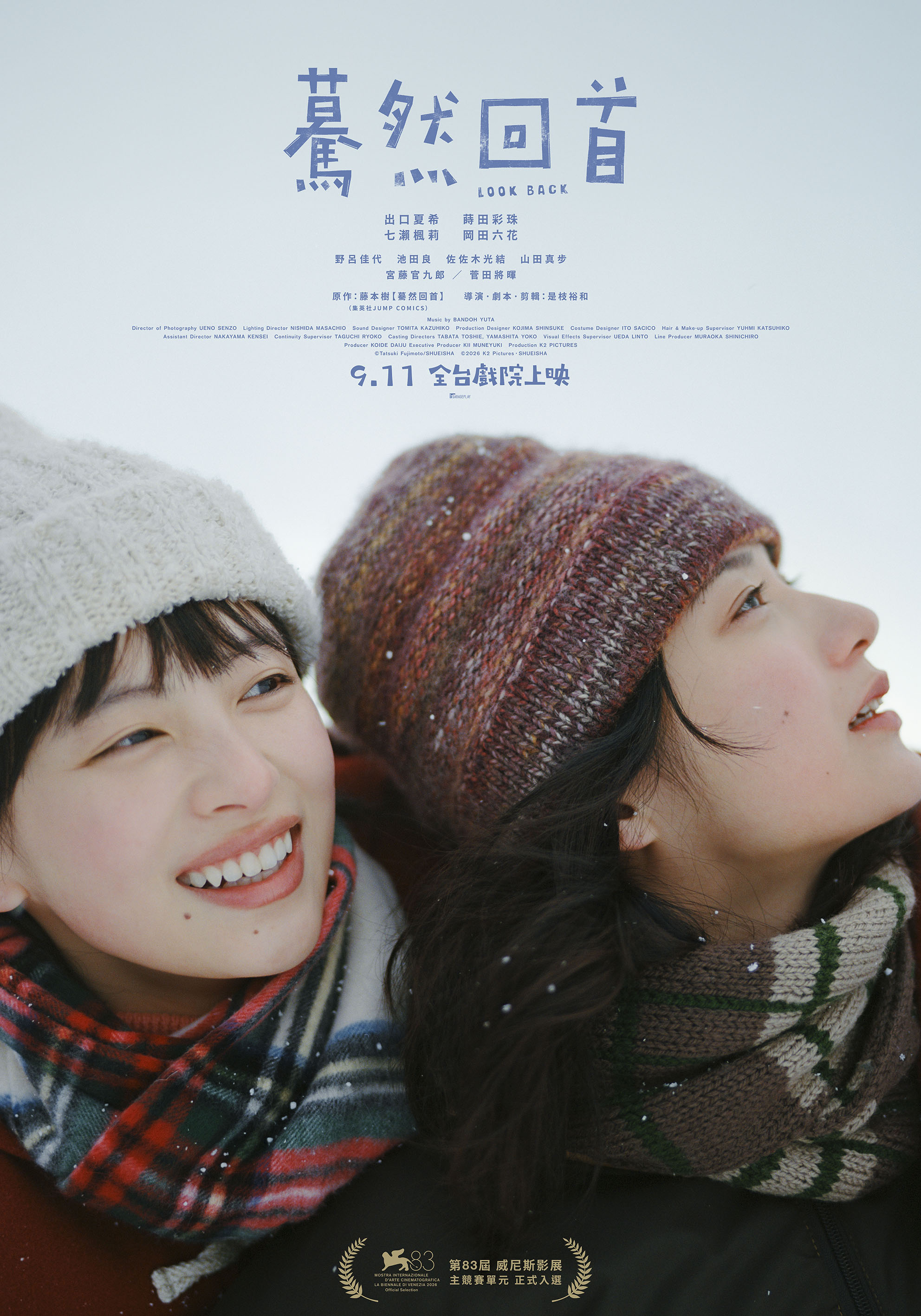
Look Back: To Every Creator
Although I'd already seen the manga and the animated film, watching the live-action version still had me smiling uncontrollably and choking up.
There are works you rationally recognize as good, and there are works that hit you so directly that your instinct is to stop trying to think about them rationally at all.
Look Back is the latter, for me.
A work about drawing. A work about youth. A work about friendship. A work with a touch of fantasy. A work about moving forward, then looking back.
But what moves me most about it is its purest possible love for the act of creation itself, and its respect for every creator.
As someone who's self-taught in drawing, I can't not empathize with this film.
Back when I used to spend days and nights at home drawing purely for the love of it, all my family ever saw was my back, folded into whatever different background I happened to be sitting in front of.
What moves me most in Look Back is exactly that — those backs, over and over.
Before anything actually happens in the story, we already see Fujino and Kyomoto each working hard at their own drawing. We watch Fujino go from studying human anatomy to perspective, to wanting to photograph anything and everything as reference material, to eventually being able to sketch out perspective lines with a few simple strokes of Photoshop's pen tool. We watch her stack of practice notebooks get thicker, her reference books pile up. All these small details land with a knowing smile.
That's exactly it — once you've learned to draw, the world looks completely different through a painter's eyes. Your world fills up with structure, light and shadow, composition, color contrast. It's like living in a parallel world of cognitive dissonance.
Not to mention the meticulous, detailed depiction Kore-eda's team brought to modern drawing techniques in the film — pen and paper, watercolor, oil paint, sketching, digital tablet work.
Watching all these fascinating drawing techniques play out, I couldn't help but remember my own delight the first time I discovered "oh, you can draw it like this." And I found myself in awe of the collective wisdom passed down through generations of artists — in their hands, even the most unremarkable little tool can become the finishing touch of a piece.
Speaking of director Kore-eda Hirokazu — what sets this film apart from the manga and the animated version, and what surprised me most, is how completely he wove in his own signature visual elements: childhood, small-town streets, fragmented everyday life.
He still shoots with that quiet, restrained camera language inherited from Ozu Yasujiro, that steady, unhurried editing rhythm, to tell this warm, delicate story.
Add to that the film's candy-colored palette and the two young leads' performances — just raw enough to feel exactly right — and it's basically the live-action version of exactly how I imagined this story in my head.
Especially the way the film uses wind.
Wind blowing through fields, ringing wind chimes, scattering dandelions, carrying cherry blossom petals.
Wind is the trigger that connects the two characters. It's the wind that blew that four-panel comic away, which is what brought Fujino and Kyomoto together in the first place.
So after Kyomoto dies, the wind stops. Even with sunlight covering the fields, everything stays completely still.
Not until Fujino tears up the four-panel comic in front of Kyomoto's door does the wind suddenly pick up again, blowing open an "if" timeline. And on the other side of that "if" line, another gust of wind, behind Kyomoto, blows the pages back through the gap in the door — connecting the two of them across time.
The film also fleshes out the storylines of the manga editor, Fujino's family, and Kyomoto's grandmother.
Did you know?
If you rub your hands together for ten seconds and hold them up to your ear, you can hear the ocean.
I actually tried it in the theater — heard nothing, for the record. But that doesn't take away from how brilliant the design is: just by adding one small, everyday detail like that, it threads together Kyomoto's grandmother, Fujino, and Kyomoto all at once, and even ties back to the double-page spread of the ocean at the end of the very first short comic.
On a related note — I'm glad they didn't overdo Kyomoto's backstory. When her grandmother's photo showed up, I genuinely got a little startled. Kore-eda clearly understands the value of leaving things unsaid.
Equally brilliant is the swan, which appears six times.
First glimpsed from a distance. Seen again right before a run. Seen taking flight. Seen by Kyomoto. Heard, its call carrying through a scene...
I'm not entirely sure what the swan is meant to represent exactly, but I read it as something like a dream, or maybe the yearning Fujino carries inside her.
The last time Fujino passes that same country road, she stops — but this time, there's no swan on screen. Just its call.
That's such a brilliant piece of design.
All these small, everyday details — the wind, the swan, the sound of the ocean, and the two of them drawing with their backs turned to us — keep the film wrapped in this strange, wonderful sense of realness. It never tries to force a heavily plotted story on you, and yet you always feel like something is happening. Something full of life and forward motion, running underneath the surface of everyday life.
The most unexpected piece of design in the whole film is the moment Fujino opens the door into Kyomoto's room, sees all the background art she'd drawn over the years, and the film suddenly slides into an animated flashback sequence. It might verge on overly sentimental, but honestly — it got my tears anyway.
My tears don't cost anything. Take them.
On the way out, a friend mentioned they preferred the ending of the animated film, where Fujino just keeps drawing until dawn. Compared to the live-action film's abrupt cut to black, I actually prefer that version too.
That said, compared to that one regret, what the film absolutely deserves credit for is how it choreographs Fujino's walk in the rain.
Honestly, reading the manga and watching the anime, that scene only ever struck me as brilliant — it never actually made me tear up. But in the live-action film, the performance, the score, and the blocking capture Fujino's joy and pride at finally being recognized — that childlike, youthful feeling — with an intensity that's almost too vivid.
Thinking back on my own experiences with drawing, screenwriting, photography, and making games, I genuinely couldn't hold it together.
Unlike most people, who cry when they get to Kyomoto's tragedy, my tears in this film are mostly reserved for the pure love of drawing that runs through the whole thing, and the respect it holds for every creator.
That's also why I really love the scene the film adds for Fujino at the very end.
Her editor tells her that a lot of creators, once they learn their work is being adapted into an anime, fall into a strange sense of loss.
It gives Fujino a feeling close to the ending of The Social Network: you finish the dream, and it somehow feels hollow anyway, as if gaining something also means losing something else.
That's also what makes it feel more powerful when Fujino later revisits Kyomoto's old house and decides to pick up her pen again.
Before she leaves Kyomoto's house, there's a montage that crosses through time.
Young Kyomoto asks Fujino:
"You said drawing isn't even fun. So why do you keep doing it?"
Adult Fujino lingers, looking back at young Kyomoto for a long moment, then turns and walks off into the night. She arrives at her desk in her studio, picks up her pen, and keeps drawing.
Because drawing was never about applause in the end. It was never about proving anything.
It's just that she still wants to draw.
Finally, let's come back to the title.
"Look Back" carries multiple meanings.
It's literally "looking at a back." It's "looking back." It's "looking back on the past." And it's also a nod to Oasis's "Don't Look Back in Anger."
Through the hatchet attack in the story, and through this title's Easter egg, Fujimoto Tatsuki also has me thinking of the creators who were lost in the Kyoto Animation arson attack.
The work they left behind is still being watched, still being loved — and all we can do is look back at what the people who can no longer keep creating left us.
Which forms a quietly clever echo with Fujimoto Tatsuki's own story as an author.
We can picture a young mangaka like this: starting out with an incredibly high reputation within the industry, growing into someone the whole manga world knows, then having the anime adaptation blow up beyond that, and eventually even having the work screened at the Toronto International Film Festival.
Kyomoto and Fujino are exactly the two halves Fujimoto split himself into.
One buries herself in drawing alone. The other longs to be recognized, longs to be seen by the world.
One turned inward. One turned outward.
But in the end, they both just wanted to draw.
That's their story. It's his story too. And, more than anything, it's every creator's story.
To every creator.